A review of The Lost Symbol
Dan Brown is not one of the premier authors of our time, at least in terms of cultural and critical reception, but for a time in the early 2000s, he was a phenomenon, getting many adaptations of his books, the most famous being the Da-Vinci code film starring Tom Hanks, which cemented him as one of the foremost popular novelists, the author who people who do not read, read, along with the likes of JK Rowling and Paulo Coelho. This was also followed by a major controversy due to the depiction of Christianity in the film and book, which might have caused him some consternation.
While the Da Vinci code is certainly the most culturally effective Dan Brown novel, he still remained a major fixture. 6 years after the book and three years after the film, he released the long-awaited sequel. The Lost Symbol. This Book did not get a Tom Hanks movie like some of its predecessors and its sequel, but a TV show instead. This is not going to factor into this review.
An Airport novel is a pejorative term for a type of book that is often associated with airport bookstores-cheap, mass market paperbacks, though not always; usually breezy and light reads, often forgotten after one reads them, which is usually when you have nothing better to do, such as when you are waiting at an airport. Dan Brown is a quintessential airport novelist. Of course, you may then ask, what is the point in criticizing something that is not trying to be good?
Well, for one, I do not think being mainly made for entertainment precludes works from trying to be good, or enjoyable. On my coverage of Agnes Grey, I said as much. It was an entertaining book without too many aspersions to higher status, but it was good at the time. The author has written another work that is much better regarded, and will review later, but the point still stands, you do not have to be highbrow to write an enjoyable novel. Does the lost symbol hold up? Does it pass the criteria? Will Dan Brown win the Nobel Prize? Take a wild guess.
Our story starts with esteemed professor and Harvard Symbologist (not a real job) Robert Langdon, who is a guest lecturer at the US capitol at the behest of a friend of his; Peter Solomon, who is a Freemason. He was also asked to bring a strange parcel entrusted to him by Solomon to his DC meeting. Robert Langdon is not an exceptional character. He wears a Mickey Mouse watch, and likes puzzles. This is the extent of his characterization. A bland protagonist is not necessarily an issue however; it just depends on how they are utilized.
However, when he reaches, Langdon finds Solomon is missing, and he was actually called by a person called “Malakh” who cut off Solomon’s hand and wants Rob to solve escape room puzzles for nefarious purposes. Langdon gets a call from the CIA director, who has a rough and gravelly voice. In the text, the character is not given any gendered pronouns in a move Dan Brown probably thought was a stroke of genius. Based on this, Robert makes the bold choice of referring to the character as sir. If you are a person who has read more than one book, or even seen more than one movie will know, you will be able to guess where this is going next. Of course, surprise, the character is a woman.
Director Sato is depicted as a no nonsense highly competent leader, but is unnecessarily abrasive and verbally abusive. I am sure nothing will come of this. She informs Langdon of the threat posed by Malakh, and tells him they need to work together. He fails to inform her about the parcel entrusted to him, but she finds out, and after some bickering, Robert is on the run from the CIA, helped by the capitol’s architect, a man by the name of Walter Bellamy, who is also a freemason.
Bellamy provides some exposition. We get a little bit of information about the antagonist, who is extremely tatted out, kinda crazy, and has an obsession with the Freemasons; having infiltrated them in recent times. The second protagonist is also introduced here, Katherine Solomon, who is Peter’s sister.
Katherine is a researcher studying Noetic science, which is a sort of pseudoscientific psychological field that believes that you can basically do magic with your mind, and she is joined by a couple of colleagues in her lab, whose names I barely remember, and I do not care enough to reopen the book to check. She is sponsored by Peter. There is also an assistant, who I think is called Pam, whose only purpose is to get killed by Malakh. He kills a few people, but most of them are not interesting enough to recount. Pam is thrown into a tank containing an alcohol solution which stores a biological specimen of a sea creature.
Katherine does not keep backups of her work. She says this is because the work is far too important and if she released information pertaining to it would have severe consequences. Apart from being a flawed sense of reasoning, the obvious happens and Malakh destroys the hard drive that holds all her data, and blows up the facility.
I have been jumping around because the narrative is not very interesting to recount. We are introduced to Katherine meeting with her psychologist, who is Moloch in disguise, caked in makeup, which Dan Brown will not let you forget. Katherine escapes the situation in the lab, and meets up with Robert and Walter. It turns out the pyramid is a map, or a part of a map, to a secret treasure of the Freemasons. The rest of the story is a scavenger hunt featuring Malakh as sort of a discount Jason Voorhees. The moment-to-moment pacing is actually decent, but this will perhaps be the only complement I will give the book
The side characters are pretty one note here. Again, simple characters are not necessarily bad, yet Dan Brown’s deployment is somehow still lacking in even the bare minimum, which is a feat almost as impressive as managing to make a bad tomato soup, which I have the unfortunate pleasure of consuming. Some of these are just oppositional, often allied with Sato, and Robert and Katherine have to outwit them to progress. Sato berates them for failure, and this gets old fast. Dan Brown intends you to take her seriously, but considering her lack of efficacy in intercepting two civilians, it is hard to do so. A lot of the traits given to her are told to us by the narrative, and since most of them do not come into play, it just feels superfluous. There is nothing wrong with using page time to give context to a character that is otherwise unimportant when the story given is interesting in its own. A lot of good authors do this, and even when characters do not resurface, if it provides flavor, it is worth it. Unfortunately, the additions to side characters in this book, and not just for Ms. Sato, are uninteresting, and distract from the few strengths this story has. Here, they are purely visual garnishing, done with no purpose but to improve the plating, and again, the main course is subpar tomato soup.
Many side characters are just cannon fodder for Malakh to kill. Having characters exist just to die can be used for a couple of things. One, of course, is to increase tension. While a genre knowledgeable person would know it is unlikely for Robert to die, having him in danger or having him experience distress can make the stakes feel more exciting. However, these are rendered irrelevant since Robert and Katherine barely react to anyone’s death. In most action stories the protagonists are people who are either actively or formerly people who have seen conflict. Robert has been in stuff like this before, but Kathy has not, and both are civilians regardless. The disposables can also exist for the spectacle and gore of their deaths. While this can work in a visual medium in a straightforward manner, if one has a good special effects team, it takes more writing skill to depict it in text, and Dan Brown does not have the chops to pull this off. Side character deaths can also work if the character themself makes the reader care about them, and their loss is felt. This does not happen often. The aforementioned coworker of Katherine makes you feel sorry for her, but it is not enough, and by the time the book comes to a close, each death feels more and more trite, as the soup makes you more and more queasy. The last, and perhaps most pertinent reason, though all these utilizations intersect with each other, and build off one another, is in service of the villain. This is the reason why I made this video. The antagonist of this book is perhaps one of the worst executed I have seen in any story ever, regardless of medium.
The Robert narrative is interspersed with flashbacks about Katherine’s nephew and peter’s son, who hates freemasonry, and rejects his father’s offer to join the organization. Women are not allowed to be Freemasons so Katherine cannot join herself, but there is not much heed given to this, though a character later in the book is part of a sister organization that is made up of only women.
I get the sense that this was included so Dan Brown did not have to answer any questions about the moral fiber of his protagonists. Peter’s son is a pretty unruly individual and lands up in prison. Peter visits him, and the guard offers to let his son go if he gives a bribe, but Solomon, due to the purity of his soul, refuses. The kid’s body ends up on the paper, having been killed for his wealth by a cell mate. Or so it seems. Malakh showed up at the Solomon compound, and killed Peter’s Wife, before being shot by Peter and falling into a creek.
Of course, the obvious plot twist can be seen a mile away. Malakh, who is really called Moloch, is Peter’s child Zachary. The idea and concept behind this are actually somewhat sound, even if slightly cliché. However, the execution is worse than you would expect. You see the twist long before it is actually revealed in one of the last chapters. There is not any character writing done with the concept. We get that he hates his dad, but it is trite and inconsequential, and the narrative treats it with a gravity it does not deserve. Neither Peter nor Katherine seem to engage with their relative after the initial shock. It is also a little odd since Peter, the main familial relation to Zachary, is also not really a major player in the book.
The ending encapsulates many of the problems with the characters. Sato tells Robert that Moloch had a video of important US officials as Freemasons, and that if he releases it, it will cause the citizens to rise up and lead to unrest in the streets. Real life shows that not to be the case, at least at the time of this video’s release, but even in 2009, apart from losing elections, there would likely not have been many long-term consequences for what is basically the expression of freedom of religion. One of the people in the video is a Supreme Court justice, a position notable in the US for being extraordinarily stable and impervious to public backlashes, so Sato comes off as again, a bit foolish. Robert and Katherine basically bumble their way into the Freemason headquarters, where Peter, who is now bald, is being held at knife point by a nude Moloch.
Moloch asks Peter to kill him, then reveals the truth about his relation. It turns out he wants to be sacrificed to become a powerful demon, and thought he needed the Freemason’s ultimate secret; a word of unimaginable power, to fulfill his dreams. Peter tells him the word, he tattoos it on his head, then slips and dies. Peter than mentions that the word that he gave was not the real one, and reveals the truth to Langdon. The real word was, the Bible. Dan Brown was in hot water with Christians, so I guess this is sort of like an apology, but man, is this unbearably cringe. Peter also tells Katherine that he backed up her hard drive, because obviously, imagine how anti climatic it would have been if she lost millions of dollars’ worth of research due to a formatting error, and gives it back to her. This rather questionable erasure of consequences is maddening, and it is even more annoying considering the half dozen casualties in the story, of whom Robert and Katherine do not seem to care much about, being in a surprisingly cheery mood at the conclusion
Having such a moron as the villain is a great depiction of the foolishness of violence, but I do not get that this was intended. Malakh is one dimensional, and his relationship with his father does not add anything to the story than a predictable twist. Robert being static does not help, and despite her relationship with him, Katherine does not have much meaningful interaction with her brother. The lack of imagination is astounding. We do not get much in the way of meaningful familial relationships, in the flashback the kid is pretty much a brat. There is a small fort that the family built, but again, this is only shown for a brief section. Katherine does see a picture book with Malakh taking steroids and tattooing himself, and reminisces about their life beforehand, but she seems more miffed that he did steroids than the fact that he is a serial killer. There is little meditation on changing family dynamics, or how it hurts having your loved one hurt you, what is there is surface level and would result in a demerit even if written for a GCSE exam. Having a plot point exist just for the sake of a twist is puerile and foolish.
So, I do not like the book, which is a sentiment shared by quite a few discerning readers, but this book was rather popular when it came out, and Dan Brown is rather successful in regards to selling books. Why is that? Well for one, for all the faults, the pacing is decent, so it is easy to read. Brainrot is not good for you either, but it is popular because it is easy to consume. Some of the trivia in relation to DC and the Freemasons, while having somewhat questionable veracity, are interesting to read about. Some of the puzzles and scenarios and concepts are interesting in theory, if nothing else.
One concept that I feel may explain Dan Brown’s popularity and lack of critical acclaim is something I like to call adjustment tolls. There are many books that I have read, great books, that confuse me for the first 30 or so pages, since I have to get used to the author’s style, the tone of the book, the world, and the themes. Salman Rushdie, Thomas Pynchon, and, Virginia Woolf, are all great authors, but when I first read their work I was a little confused with what they wanted to say, and what they were saying. You have to give up a little of your time and effort to fully enjoy the best of what they have to offer, a toll, if you will. Dan Brown gets you from the first page, which is a skill of its own, but there is rarely any reward afterwards.
By far the most glaring failure of this work are the characters. Many of these are just purely functional, but nothing else. Some of them are even less. I did not mention one character, who is a typical cliché hacker guy who does hacker things from a 90s movie. He basically sucks up word count, since everything he does is basically pointless. The other big failure is the lack of consequences, which makes what you read feel pointless. Dan Brown never comes out and says, it was all a dream, but most plot decisions feel just as egregious. As a tangent, many it was a dream all along stories, especially in video games, are surprisingly poignant, due to consequences. Some of the pictures up are fake, so do not worry about spoilers.
Back to the characters. Static characters are not necessarily a bad thing. This is a common trope in serialized works, such as detective fiction. Hercule Poirot and Sherlock Holmes rarely change between stories. Robert Langdon, as a recurring static protagonist is fine in principle. However, Poirot and Holmes have one leg up, often having other characters go through changes and emotions and growth in their works. Holmes, unlike his modern depiction, cares deeply about people. He will break the law if it necessary to, if he feels that there is an injustice committed. Poirot is similar, he will also sacrifice the letter of the law for its spirits. They are also often surrounded by characters that react to their surroundings, and who grow and change. The villains are also more interesting in often being people that could reasonably exist, some do stretch the limits of imagination, but others are sources of social commentary, even if unintentionally.
Langdon’s supporting cast, especially Katherine and Peter, cannot keep up with what the story requires of them. They do not react to the villain in a way that is interesting or meaningful. They do not grow or change much beyond superficial ways. The villain is also, as mentioned before, quite bad, but there is the possibility of a good story here. Umberto Eco’s books, Foucault’s Pendulum, and the Name of the Rose, both have twist villains of sorts, and exist on a sort of tight rope between genre and literary fiction, but the villains in both, despite having similar screen time to our antagonist here, make a point about the world they inhabit, and force the characters to change and grow. These books also have consequences. Spoilers for the name of the rose. At the climax of the book, a huge library that is the centerpiece of the narrative is destroyed, in a similar way as to Katherine’s hard drive. This time, there is no rescue. It is gone for good, and it can never be brought back. Having Peter keep a back up of the hard drive may perhaps seem satiating in the moment, but it is a hollow victory. Eco has talked about Dan Brown in an interview, and well, gets the sense that Brown is a background characters in Foucault’s Pendulum. I agree with that sentiment. I would be remiss if I did not mention Michael Deacon review of this book’s successor, “Don’t Make Fun of Renowned Author Dan Brown”. Read it if you have not already.
MyAs for my final word. Dan Brown’s The Lost Symbol is a weak, scurrilous work that wishes it did not exist, with an interesting hook, pacing, progression, and ideas, that are wasted on pseudoscientific prattling, weak characters, a story with no point, a horrible villain, and an extreme aversion to meaningful consequences.
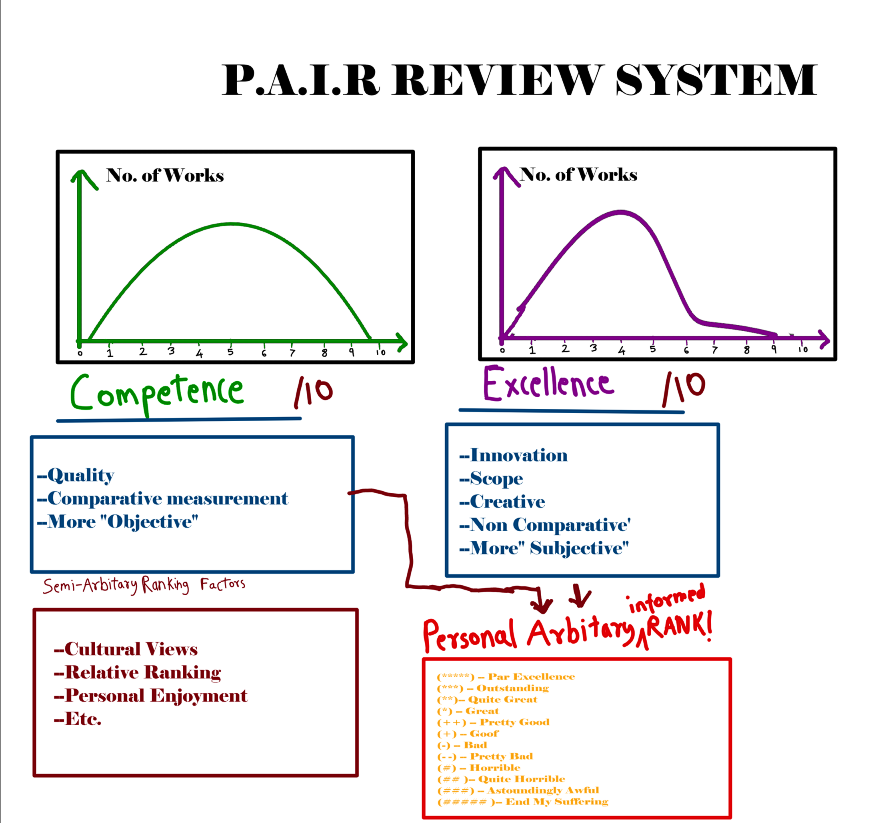
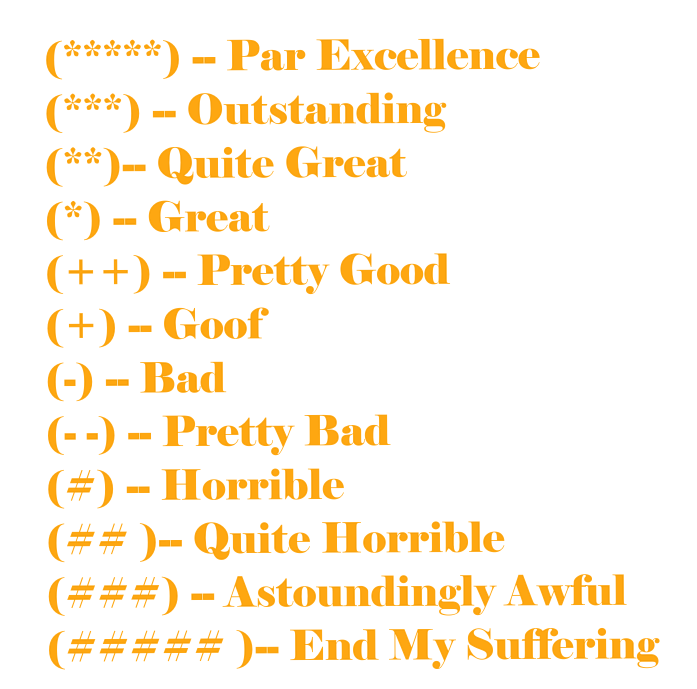
My ranking is explained in the sidebar. It gets a 2 in competence and a 1 in excellence. The PAIR score is a double hashtag.
It is not a good book, and any positives are outweighed by the baffling choices and lack of imagination. For a food pairing, I would say it is akin to a bad Tomato Soup.